The Bordeaux barrel: how did it become the global standard for wine ageing?
If someone asks you to picture a wine barrel, chances are… you are imagining a Bordeaux barrel.
With its famous 225-litre capacity, this oak barrel has become, over the centuries, a true benchmark in wineries around the world. But this size was not chosen by chance. Far from it. Why exactly 225 litres? Why is this format used so widely? What flavours does it bring to wine? And why are some winemakers now turning to larger ageing vessels?
Let’s uncover the story behind one of the most iconic tools in winemaking.
What is a Bordeaux barrel?
A Bordeaux barrel is a 225-litre oak cask mainly used for wine ageing. It is made from around thirty curved wooden planks, known as staves, carefully assembled without glue or screws and held together only by metal hoops.
Its ability to hold liquid relies entirely on the craftsmanship of the cooper and the natural swelling of the wood when it comes into contact with wine.
Today, the Bordeaux barrel is used far beyond its original region. From Bordeaux to Burgundy, Tuscany, California, Australia and South America, this oak barrel has become a true international standard in the wine world.
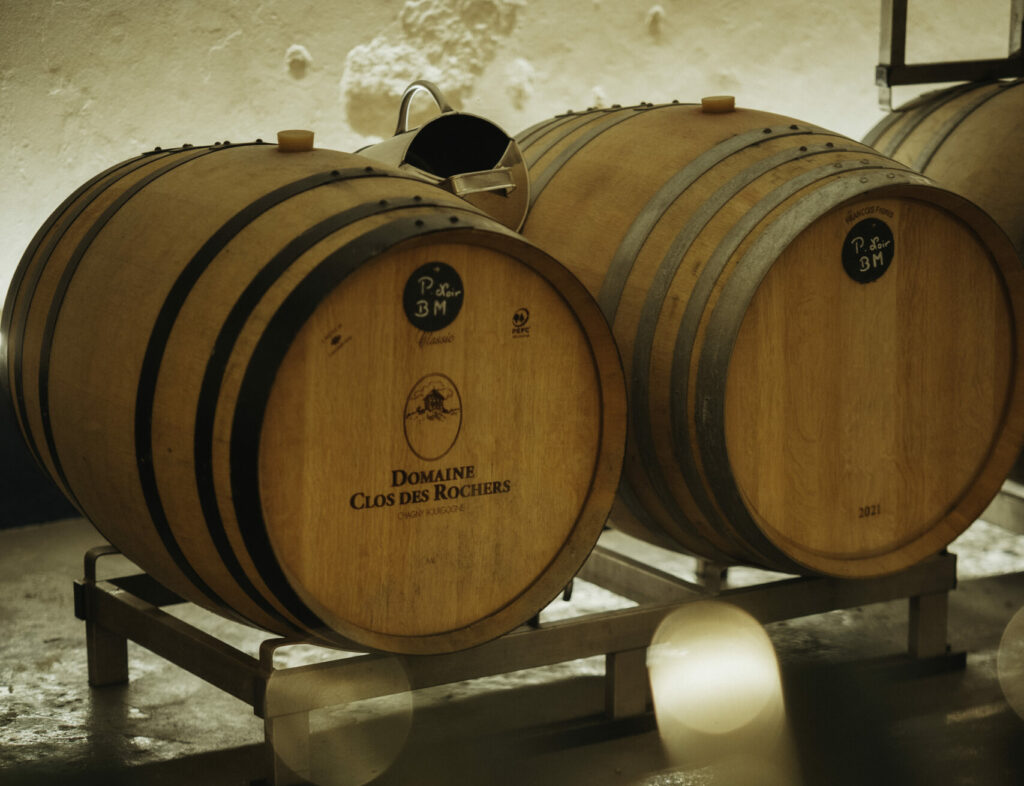
Why does a Bordeaux barrel hold 225 litres?
The answer lies in the history of wine trade. During the 18th century, Bordeaux exported a large part of its wines to England and Northern Europe. Producers needed a container that was large enough to make transport more efficient, but still practical enough to be handled by workers. The 225-litre barrel quickly proved to be the perfect balance between transport, storage and wine preservation.
And centuries later, this format is still highly appreciated by winemakers for one simple reason: it offers an ideal balance between the influence of oak and the evolution of the wine.
What is the role of a barrel during wine ageing?
Unlike a stainless-steel tank or a concrete vat, a barrel is not just a place where wine waits patiently. It actively contributes to the wine’s development through two key processes.
Natural micro-oxygenation
Oak is a naturally porous material. Without allowing the wine to escape, it enables very small amounts of oxygen to slowly pass between the outside environment and the wine.
This gentle micro-oxygenation process helps to:
- soften tannins;
- improve colour stability in red wines;
- support the gradual development of aromas;
- create a smoother and more balanced mouthfeel.
These oxygen exchanges are extremely subtle, but they play a crucial role in shaping the final balance and character of the wine.
An aromatic contribution
A barrel does more than simply hold wine. It also releases naturally occurring compounds from the wood, adding another layer of complexity.
Depending on the origin of the oak, the level of toasting and the age of the barrel, the wine may develop aromas of:
- vanilla;
- toasted bread;
- cedar;
- black pepper;
- clove;
- coffee;
- cocoa;
- coconut;
- smoky notes.

Why is oak used for wine barrels?
Not every type of wood is suitable for barrel ageing.
Oak has several essential qualities that make it the preferred choice among winemakers:
- excellent strength and durability;
- ideal porosity for controlled oxygen exchange;
- low liquid permeability;
- natural richness in aromatic compounds.
Coopers mainly use French oak and American oak, each bringing its own distinctive style and aromatic profile.
French oak is often valued for its elegance, subtle spice notes and fine structure, while American oak tends to release more noticeable aromas of vanilla, coconut and caramel.
Do all barrels have the same influence on wine?
Not all barrels affect wine in the same way.
A new oak barrel releases a higher amount of aromatic compounds and tannins from the wood. With each use, this influence gradually decreases.
After several vintages, the barrel continues to play an important role through micro-oxygenation, but its aromatic contribution becomes much more subtle.
This is why many wineries combine new barrels with older barrels that have already aged one or several wines. The aim? To achieve the perfect balance between oak character and the natural expression of the wine.
Why is barrel toasting so important?
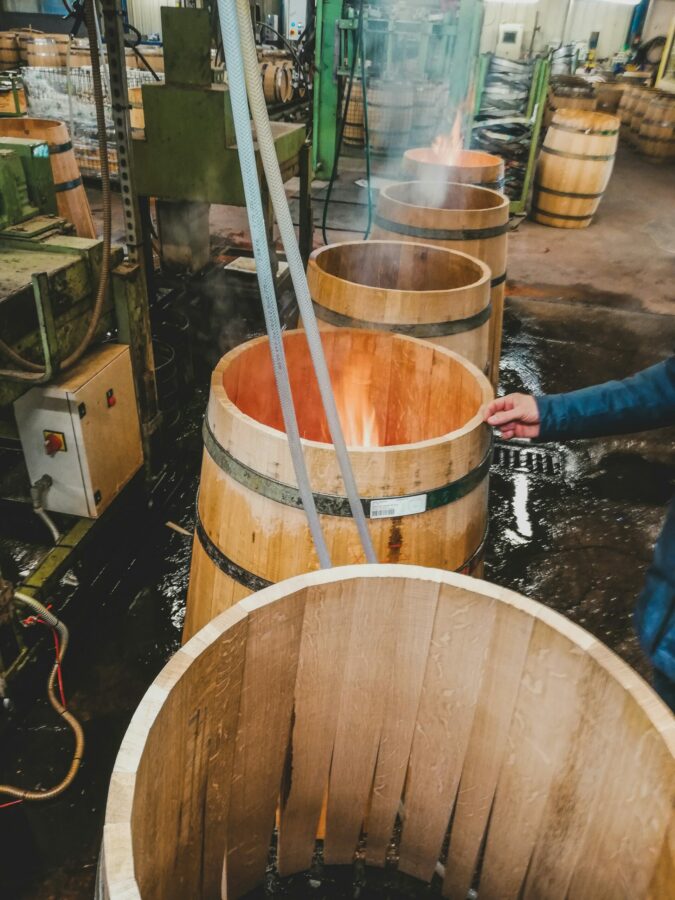
Before being assembled into a barrel, oak staves are heated over a fire. This essential step allows the wood to be bent into shape, but it also has a major influence on the future aromatic profile of the barrel.
The level of toasting plays a key role:
- Light toast highlights the natural characteristics of the oak and preserves its original structure.
- Medium toast develops aromas of vanilla, toasted bread and spices.
- Heavy toast brings out deeper notes of coffee, cocoa, caramel and smoky flavours.
In other words, two barrels made from the exact same oak can create completely different results depending on their level of toasting.
Are all wines suitable for barrel ageing?
Not necessarily.
Barrel ageing is a winemaking choice, not an automatic sign of quality.
Some wines are crafted to preserve a bright fruit profile, vibrant freshness or a pure expression of the grape variety. In these cases, a stainless-steel tank or concrete vat may often be the better choice.
On the other hand, more structured wines with enough concentration and ageing potential can benefit from the complexity, depth and texture that oak brings.
Ultimately, the decision always depends on the style the winemaker wants to create.
In conclusion:
The Bordeaux barrel has become a worldwide benchmark thanks to its unique balance between tradition, practicality and winemaking performance.
It contributes to:
- gradual micro-oxygenation;
- harmonious wine development;
- controlled aromatic integration.
However, its influence always depends on several factors: the origin of the oak, the level of toasting, the age of the barrel, the length of ageing… and above all, the choices made by the winemaker.
Because, in the end, a barrel is not there to transform a wine into something else. Its role is to support its evolution, enhance its personality and reveal its full potential.
Want to go further into the world of wine?
Understanding the influence of barrels, winemaking techniques and ageing choices is an essential part of wine knowledge — and one of the key topics covered in WSET courses.
At the Bernard-Massard Wine Academy in Luxembourg, our WSET Levels 1 to 3 courses go beyond simple tasting. They help participants understand how every decision — from the vineyard to the bottle — shapes the style, quality and identity of a wine.
Founded in 2023 by Bernard-Massard, a key name in Luxembourg’s wine industry since 1921, the academy supports wine enthusiasts, passionate learners and professionals in developing their knowledge through internationally recognised training programmes.